
Pawnee Release Status Differences
Parole, postrelease supervision, probation, and community corrections are not interchangeable. Parole is supervised release from prison under rules that apply to an older indeterminate sentence. Postrelease supervision follows the prison part of many determinate Kansas sentences. Probation is a court-ordered alternative to confinement or a condition imposed after a jail term. Community corrections is a more structured local supervision program used when ordered by the court. Diversion supervision is another distinct path. The document that placed the person under supervision controls.
| Status | Primary Pawnee County verification source |
|---|---|
| Parole or postrelease | KASPER, then KDOC Great Bend Parole Office |
| Community corrections | Court order and Pawnee County Community Corrections |
| Court probation | Pawnee County District Court register and court services |
| Discharged | KASPER or the agency's discharge record, matched to the correct episode |
A county-jail release on bond can also carry court conditions without creating KDOC parole. Likewise, a person leaving Larned State Correctional Facility may enter parole or postrelease supervision. Do not infer the status from the facility name alone. Read the latest court order, KASPER status, or KDOC release document.
Check Pawnee Post-Release Supervision
Start with the last custodian. For a state-prison episode, use the official KASPER search. A KDOC number is the strongest search key. Exact name, alias, conviction county, parole supervision county, community-corrections location, facility, and supervision type can narrow a search when no number is known. Read the supervision type before reading dates.
- Confirm whether the last custody was the Pawnee County Jail or a KDOC prison such as LSCF.
- For KDOC custody, search KASPER and distinguish Inmate, Parole, Community Corr., Discharged, and Absconder.
- For Parole or postrelease supervision assigned to Pawnee, contact the Great Bend Parole Office with the KDOC number.
- For a local community-corrections order, read the Pawnee court case and contact Pawnee County Community Corrections.
- For court probation, use the Pawnee County District Court record and the office named in the order.
- Record the source, access date, status wording, and the custody episode it describes.
KASPER updates each working day rather than continuously. Its public display may change between updates. A result also does not establish that a person now lives in Pawnee County. Conviction county, supervision county, facility, and proposed residence answer different questions.
Great Bend Handles Pawnee Parole
Pawnee County KDOC parole and postrelease cases are served by the Great Bend Parole Office in KDOC's North Region. This is a crucial local distinction. The state office is outside Pawnee County, while the county has its own community-corrections office in Larned. A generic request to a “probation office” can therefore reach the wrong agency.
The KDOC listing says the Great Bend office covers Barton, Pawnee, and Rush counties. KDOC also lists an Automated Reporting System at 866-570-7225. That number should not be treated as a universal reporting method. Only the supervising officer or agency can say whether a particular person is permitted or required to use it.
The linked official contact listing is shown below so the agency name and service area can be checked against the surrounding guidance.
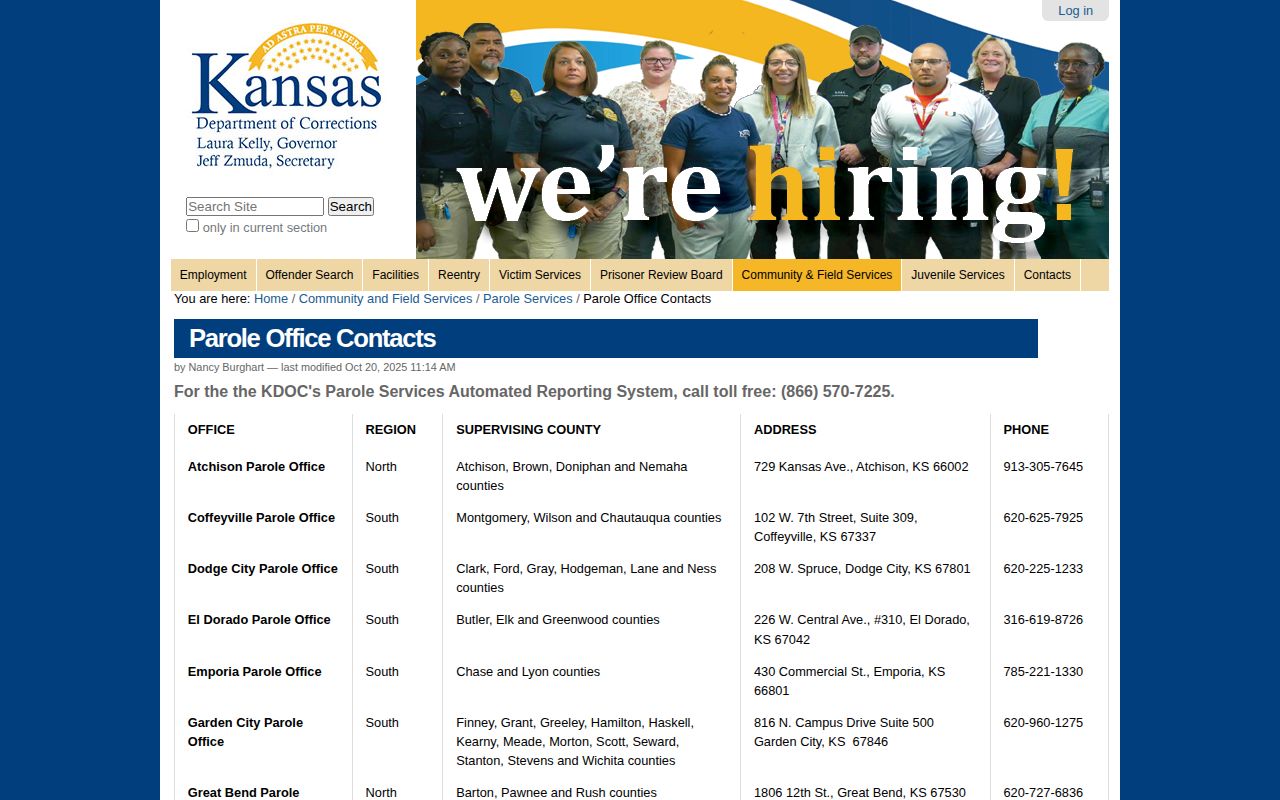
The screenshot supports routing a Pawnee parole question to Great Bend, not to the Pawnee County Jail or local community-corrections office.
Pawnee Community Corrections Is Separate
Pawnee County Community Corrections is at 606 Topeka St., Larned, KS 67550. Its phone is 620-285-3128 and fax is 620-285-3120. The county page describes programs that include Adult Felony Diversion Supervision. It does not say the office serves as the KDOC parole office, nor does it establish that every person released in Pawnee is supervised there.
Use the actual court order to identify community corrections, court services, probation, or diversion. The 24th Judicial District record can show the sentence, supervision order, later modification, violation filing, revocation, satisfaction, or discharge. It supplies legal context. The responsible office supplies current supervision confirmation.
Local supervision is also distinct from in-facility reentry work. LSCF documents programs such as Thinking for a Change and other risk- and need-based support. Those programs occur in the prison setting and do not promise a universal public service after release. Pawnee Community Corrections likewise documents specific programs, not an open-ended post-release service for everyone leaving custody.
KASPER Has a Probation Gap
KASPER warns that it cannot currently display community-corrections probation events after April 21, 2021 because of a data-modernization issue. That gap matters in Pawnee County. A no-hit or old status cannot be treated as proof that local community-corrections supervision ended. Direct confirmation from the agency and the latest court entry are needed.
Public KASPER status choices include Absconder, Community Corr., Deceased, Discharged, Discharged-Deceased, Inmate, Parole, Unknown, and All. “Inmate” means current KDOC custody, even when the Pawnee County Jail no longer holds the person. “Parole” means prison confinement ended but supervision continues. “Discharged” is the closest public search status to a completed state custody or supervision episode, but the precise state document still controls.
This limitation also keeps systems in their proper lanes. Direct county bond-outs, dismissals, short jail terms, and court probation may never appear in KASPER. Use the sheriff and court for a Pawnee County Jail episode. Use KASPER only when KDOC custody or supervision is involved.
Pawnee Absconder Lists Differ
Kansas publishes separate KASPER lists for parole absconders and community-corrections absconders. Their separation reflects the different supervision systems. K.S.A. 75-5217 describes absconding as knowingly avoiding supervision or making one's whereabouts unknown to the supervising officer.
“Absconder” is not a substitute for a verified warrant. KASPER warns that no one should be arrested based only on its display. Safe wording is that a person was listed by KASPER as an absconder on the date checked, followed by confirmation with the supervising agency or law enforcement. Do not turn a public database result into instructions for private action.
The official parole list is pictured below after the linked source introduction.
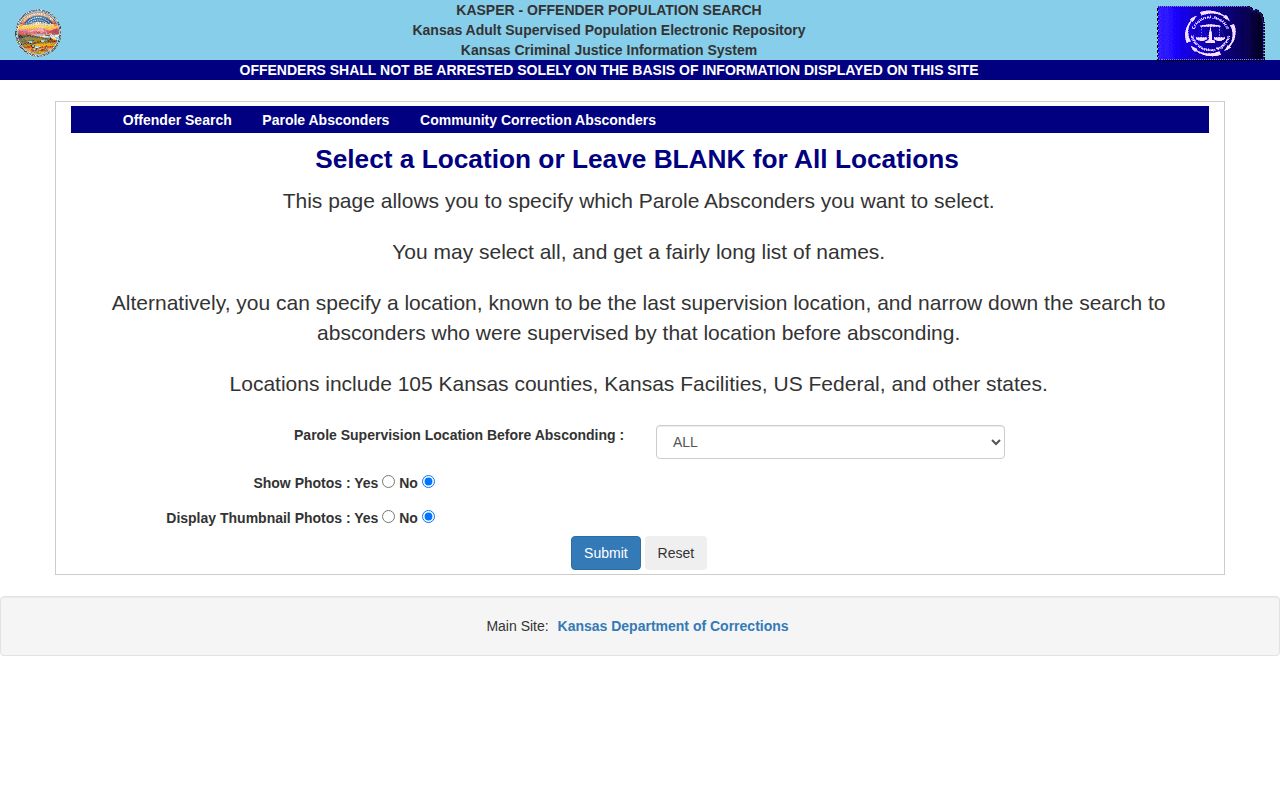
Its separate format reinforces why the precise supervision type must be identified before contacting an office.
Correct Pawnee State Records
KASPER accepts written accuracy comments at kdoc_pub@ks.gov. That path is for KDOC public-record issues. A Pawnee sheriff booking or release error belongs with the sheriff's records custodian, while a court docket issue belongs with the clerk or court process. One agency should not be asked to alter another agency's record.
Provide the KDOC number, the exact field in question, the date viewed, and the supporting document when requesting review. KASPER also cautions that an image's database-recording date may not be the date the picture was taken. Accuracy review does not promise removal or a change to an accurate historic record.
When Pawnee Supervision Ends
A supervision episode can end through completion, authorized early discharge, maximum-sentence discharge, or another formal action. Leaving prison is not enough. A Parole result shows community release with continuing state control. A Discharged result points toward the end of the applicable KDOC episode. Court probation or community corrections ends through the court and supervising system, not through a county-jail roster.
For a durable record, request the public release or discharge document from KDOC and identify the KDOC number. For a local case, read the final journal entry, satisfaction, or discharge filing. Keep later revocation episodes separate from the original release. The broader Pawnee County released inmate search explains how the sheriff transaction and court chronology establish a county-jail departure.
Pawnee Parole Hearing Records
The Kansas Prisoner Review Board process can add context before parole begins. KDOC holds monthly public-comment sessions for people with upcoming parole-eligibility hearings. Current scheduling describes public comment one month before the hearing and a possible release in the following month. That sequence is a planning calendar, not a promise that parole will be granted or that release will occur on a particular day.
The current offender list includes commitment name, KDOC number, county of offense, case number, offense, and institution grouping. Its county field is the county of conviction. It does not prove the person will return to Pawnee County, be supervised in Pawnee, or reside at a public address there. Match the KDOC number and case before connecting a hearing entry to a KASPER record.
Board outcomes include Parole, Continue, and Pass. Parole is an approval subject to release processing and supervision arrangements. Continue moves consideration to a later time. Pass has its own board meaning and should be read from the issued record rather than paraphrased as a final denial. K.S.A. 22-3717 governs eligibility, including rules for indeterminate sentences and listed exceptions. Eligibility allows consideration; it does not establish suitability or physical departure.
No official public name-searchable statewide archive of final Prisoner Review Board decisions was located as of July 18, 2026. When the precise outcome matters, request the Board record using the hearing month and KDOC number. Then compare it with KASPER and the Great Bend Parole Office. The Board record explains the decision, KASPER supplies the public status, and the field office confirms current Pawnee supervision when authorized.